March 20 Spring Equinox Sunset Watch — 2019

It’s time for the 40th seasonal sunset watch!

40!!!

  • When: Wednesday, March 20, 7:00pm (so come at 6:30pm)

    • Actual sunset is supposed to be at 7:22pm, but we have noticed that the Sun sets about 15 minutes earlier than the USNO says, because of the horizon altitude.
    • The equinox moment is Wednesday, March 20, 2:58pm
  • Where: Solstice Park – all the way up the hill from the tennis courts (or, if you’re not in Seattle, wherever you have a view of the western horizon!)
  • Who: Everyone welcome, as usual. (Please do leash your dogs as we usually have a good number of people, kids, and other dogs around.)
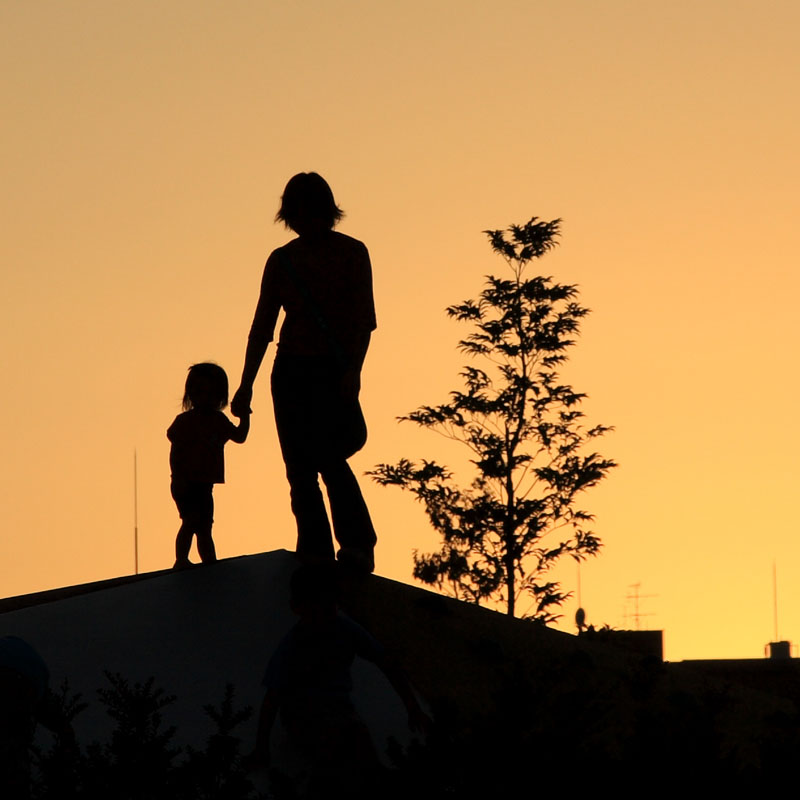
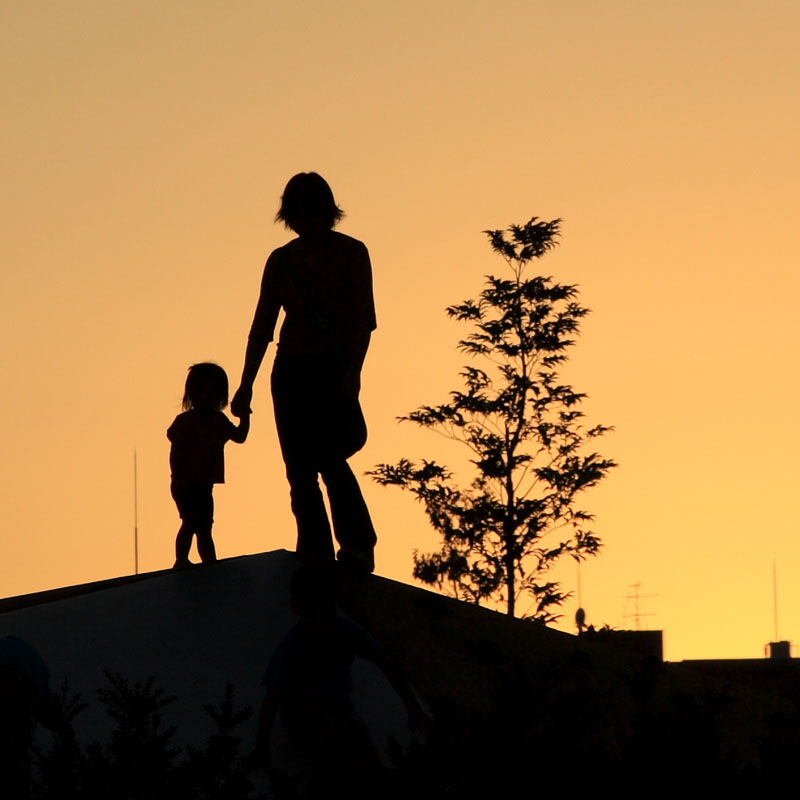
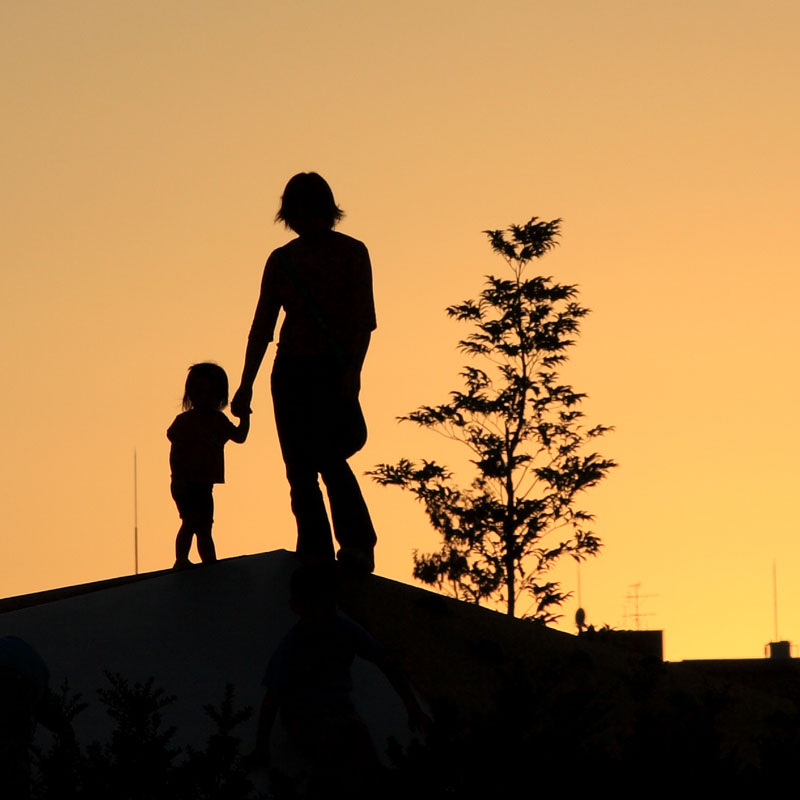
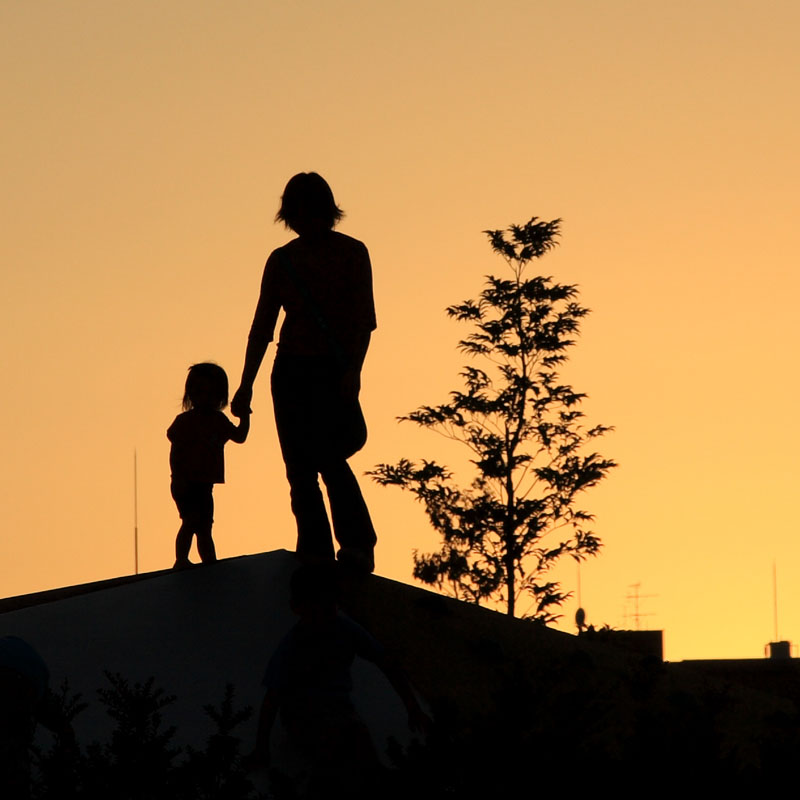
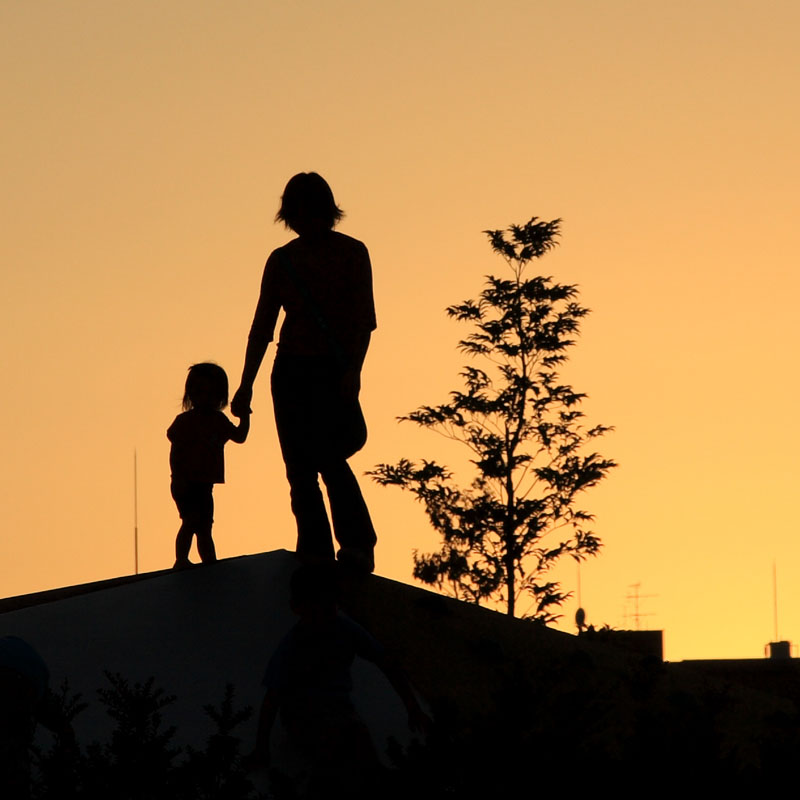
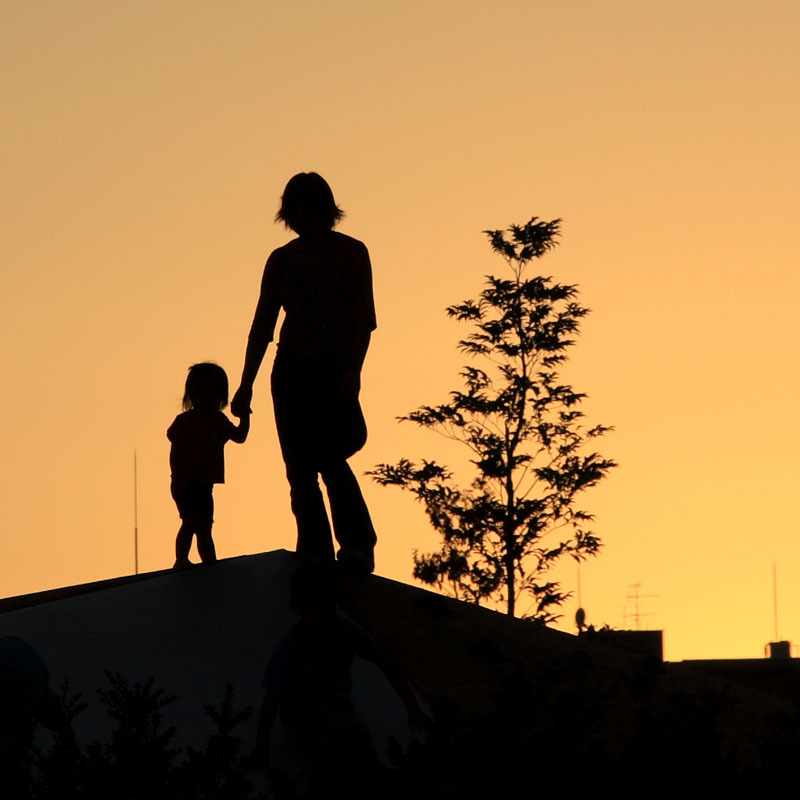
Parent and Child at Sunset by Kazuhiko Teramoto

Parent and Child at Sunset by Kazuhiko Teramoto, skyseeker

Come watch the sunset at Solstice Park in West Seattle. I’ll be there even if it is cloudy because sometimes the Sun peeks through just as it begins to set, but if it is driving rain or a thunderstorm I’m staying home with some tea!

If you’re interested – here’s the timing of various celestial events  from Seattle, courtesy of the U.S. Naval Observatory Astronomical Applications Department:

Sun and Moon Data for One Day

U.S. Naval Observatory
Astronomical Applications Department
Seattle, King County, WA (Longitude W122° 20′, Latitude N47° 38′)

Wednesday, March 20, 2019 Pacific Daylight Time
Sun
Begin civil twilight 6:42 a.m.
Sunrise 7:12 a.m.
Sun transit 1:17 p.m.
Sunset 7:22 p.m.
End civil twilight 7:53 p.m.
Moon
Moonrise 5:47 p.m. on preceding day
Moon transit 12:45 a.m.
Moonset 7:28 a.m.
Moonrise 7:08 p.m.
Phase of the Moon on March 20, 2019: Full Moon at 6:43 p.m. (local daylight time)

This event is my part of the NASA’s Solar System Ambassador program, and thanks to West Seattle Blog for publicizing all of them!

Everyone is welcome, see you there!

~ A l i c e !

September 19 Fall Equinox Sunset Watch — 2018

It’s time for the 38th seasonal sunset watch!

  • When: Wednesday September 19, 6:55pm (so come at 6:30pm)

    • Actual sunset is supposed to be at 7:13pm, but we have noticed that the Sun sets about 10 minutes earlier than the USNO says, because of the horizon altitude.
    • The equinox moment is Saturday, September 22, 6:54pm
  • Where: Solstice Park – all the way up the hill from the tennis courts (or, if you’re not in Seattle, wherever you have a view of the western horizon!)
  • Who: Everyone welcome, as usual. (Please do leash your dogs as we usually have a good number of people, kids, and other dogs around.)
Parent and Child at Sunset by Kazuhiko Teramoto

Parent and Child at Sunset by Kazuhiko Teramoto, skyseeker

Come watch the sunset at Solstice Park in West Seattle. I’ll be there even if it is cloudy because sometimes the Sun peeks through just as it begins to set, but if it is driving rain or a thunderstorm I’m staying home with some tea!

If you’re interested – here’s the timing of various celestial events  from Seattle, courtesy of the U.S. Naval Observatory Astronomical Applications Department:

Sun and Moon Data for One Day

U.S. Naval Observatory
Astronomical Applications Department
Seattle, King County, WA (Longitude W122° 20′, Latitude N47° 38′)

Wednesday, September 19, 2018 Pacific Daylight Time
Sun
Begin civil twilight 6:21 a.m.
Sunrise 6:52 a.m.
Sun transit 1:03 p.m.
Sunset 7:13 p.m.
End civil twilight 7:44 p.m.
Moon
Moonset 1:15 a.m.
Moonrise 4:56 p.m.
Moon transit 9:31 p.m.
Moonset 2:10 a.m. on following day
Closest Primary Moon Phase: First Quarter on September 16, 2018 at 4:15 p.m. (local daylight time)

Phase of the Moon on September 19, 2018: Waxing Gibbous with 76% of the Moon’s visible disk illuminated.

Sun and Moon Data for One Day
U.S. Naval Observatory
Astronomical Applications Department
Seattle, King County, WA (Longitude W122° 20′, Latitude N47° 38′)

Saturday, September 22, 2018 Pacific Daylight Time
Sun
Begin civil twilight 6:25 a.m.
Sunrise 6:56 a.m.
Sun transit 1:02 p.m.
Sunset 7:07 p.m.
End civil twilight 7:37 p.m.
Moon
Moonset 4:11 a.m.
Moonrise 6:32 p.m.
Moon transit 11:49 p.m.
Moonset 5:14 a.m. on following day
Closest Primary Moon Phase: Full Moon on September 24, 2018 at 7:52 p.m. (local daylight time)

Phase of the Moon on September 22, 2018: Waxing Gibbous with 95% of the Moon’s visible disk.

This event is my part of the NASA’s Solar System Ambassador program, and thanks to West Seattle Blog for publicizing all of them!

Everyone is welcome, see you there!

~ A l i c e !

June 16 Summer Solstice Sunset Watch — 2018

It’s time for the 37th seasonal sunset watch!

  • When: Saturday, June 16 at 8:50pm (so come at 8:30pm)

    • Actual sunset is supposed to be at 9:09pm, but we have noticed that the Sun sets about 10 minutes earlier than the USNO says, because of the horizon altitude.
    • The solstice moment is Thursday, June 21 at 3:07am
  • Where: Solstice Park – all the way up the hill from the tennis courts (or, if you’re not in Seattle, wherever you have a view of the western horizon!)
  • Who: Everyone welcome, as usual. (Please do leash your dogs as we usually have a good number of people, kids, and other dogs around.)
Parent and Child at Sunset by Kazuhiko Teramoto

Parent and Child at Sunset by Kazuhiko Teramoto, skyseeker

Come watch the sunset at Solstice Park in West Seattle. I’ll be there even if it is cloudy because sometimes the Sun peeks through just as it begins to set, but if it is driving rain or a thunderstorm I’m staying home with some tea!

If you’re interested – here’s the timing of various celestial events  from Seattle, courtesy of the U.S. Naval Observatory Astronomical Applications Department:

Sun and Moon Data for One Day

Sun and Moon Data for One Day
U.S. Naval Observatory
Seattle, King County, WA (Longitude W122° 20′, Latitude N47° 38′)
Saturday, June 16, 2018 Pacific Daylight Time
Sun
Begin civil twilight 4:30 a.m.
Sunrise 5:11 a.m.
Sun transit 1:10 p.m.
Sunset 9:09 p.m.
End civil twilight 9:50 p.m.
Moon
Moonrise 8:33 a.m.
Moon transit 4:18 p.m.
Moonset 11:54 p.m.
Closest Primary Moon Phase: New Moon on June 13, 2018 at 12:43 p.m. (local daylight time)
Phase of the Moon on June 16, 2018: Waxing Crescent with 13% of the Moon’s visible disk illuminated.

Sun and Moon Data for One Day
U.S. Naval Observatory
Astronomical Applications Department
Seattle, King County, WA (Longitude W122° 20′, Latitude N47° 38′)

Thursday, June 21, 2018 Pacific Daylight Time
Sun
Begin civil twilight 4:31 a.m.
Sunrise 5:11 a.m.
Sun transit 1:11 p.m.
Sunset 9:11 p.m.
End civil twilight 9:52 p.m.
Moon
Moonset 1:59 a.m.
Moonrise 2:37 p.m.
Moon transit 8:36 p.m.
Moonset 2:24 a.m. on following day
Closest Primary Moon Phase: First Quarter on June 20, 2018 at 3:51 a.m. (local daylight time)

Phase of the Moon on June 21, 2018: Waxing Gibbous with 64% of the Moon’s visible disk illuminated.

This event is my part of the NASA’s Solar System Ambassador program, and thanks to West Seattle Blog for publicizing all of them!

Everyone is welcome, see you there!

~ A l i c e !

December 21 Winter Solstice Sunset Watch–2017

It’s time for the 35th seasonal sunset watch!

I can’t wait to see you for a chilly winter sunset. We’ll also watch for the fingernail-crescent of the Moon just after sunset.

  • When: Thursday, December 21 at 4:05pm (so come at 3:45pm)

    • Actual sunset is supposed to be at 4:20pm, but we have noticed that the Sun sets about 10 minutes earlier than the USNO says, because of the horizon altitude.
    • The equinox moment is Thursday, December 21 at 8:28am
  • Where: Solstice Park – all the way up the hill from the tennis courts (or, if you’re not in Seattle, wherever you have a view of the western horizon!)
  • Who: Everyone welcome, as usual. (Please do leash your dogs as we usually have a good number of people, kids, and other dogs around.)
Parent and Child at Sunset by Kazuhiko Teramoto

Parent and Child at Sunset by Kazuhiko Teramoto, skyseeker

Come watch the sunset at Solstice Park in West Seattle. I’ll be there even if it is cloudy because sometimes the Sun peeks through just as it begins to set, but if it is driving rain or a thunderstorm I’m staying home with some tea!

If you’re interested – here’s the timing of various celestial events  from Seattle, courtesy of the U.S. Naval Observatory Astronomical Applications Department:

Sun and Moon Data for One Day

U.S. Naval Observatory
Astronomical Applications Department

Seattle, King County, WA (Longitude W122° 20′, Latitude N47° 38′)

Thursday, December 21, 2017 Pacific Standard Time
Sun
Begin civil twilight 7:19 a.m.
Sunrise 7:55 a.m.
Sun transit 12:08 p.m.
Sunset 4:20 p.m.
End civil twilight 4:56 p.m.
Moon
Moonrise 10:09 a.m.
Moon transit 2:56 p.m.
Moonset 7:48 p.m.
Closest Primary Moon Phase: New Moon on December 17, 2017 at 10:30 p.m. (local standard time)

Phase of the Moon on December 21, 2017: Waxing Crescent with 11% of the Moon’s visible disk illuminated.

This event is my part of the NASA’s Solar System Ambassador program, and thanks to West Seattle Blog for publicizing all of them!

Everyone is welcome, see you there!

~ A l i c e !

September 22 Fall Equinox Sunset Watch–2017

It’s time for the 34th seasonal sunset watch!

We’ll also share eclipse stories and favorite moments or pictures from Cassini (RIP, now part of Saturn). If you drew a picture of the eclipse, either before or after I would absolutely love to see it.

  • When: Friday, September 22 at 6:55pm (so come at 6:35pm)

    • Actual sunset is supposed to be at 7:06pm, but we have noticed that the Sun sets about 10 minutes earlier than the USNO says, because of the horizon altitude.
    • The equinox moment is Friday, September 22 at 1:02pm
  • Where: Solstice Park – all the way up the hill from the tennis courts (or, if you’re not in Seattle, wherever you have a view of the western horizon!)
  • Who: Everyone welcome, as usual. (Please do leash your dogs as we usually have a good number of people, kids, and other dogs around.)
Parent and Child at Sunset by Kazuhiko Teramoto

Parent and Child at Sunset by Kazuhiko Teramoto, skyseeker

Come watch the sunset at Solstice Park in West Seattle. I’ll be there even if it is cloudy because sometimes the Sun peeks through just as it begins to set, but if it is driving rain or a thunderstorm I’m staying home with some tea!

If you’re interested – here’s the timing of various celestial events  from Seattle, courtesy of the U.S. Naval Observatory Astronomical Applications Department:

Sun and Moon Data for One Day

Equinox Moment (Seattle): Tuesday, Sept 22 1:02pm
Equinox Moment (UTC): Sept 22 20 02

Seattle, King County, WA (Longitude W122° 20′, Latitude N47° 38′)

Friday, September 22, 2017 Pacific Daylight Time
Sun
Begin civil twilight 6:26 a.m.
Sunrise 6:57 a.m.
Sun transit 1:02 p.m.
Sunset 7:06 p.m.
End civil twilight 7:37 p.m.
Moon
Moonrise 9:29 a.m.
Moon transit 3:09 p.m.
Moonset 8:40 p.m.
Closest Primary Moon Phase: New Moon on September 19, 2017 at 10:30 p.m. (local daylight time)

Phase of the Moon on September 22, 2017: Waxing Crescent with 7% of the Moon’s visible disk illuminated.

This event is my part of the NASA’s Solar System Ambassador program, and thanks to West Seattle Blog for publicizing all of them!

Everyone is welcome, see you there!

~ A l i c e !

Spring Equinox Sunset Watch – 2015

It’s time for the 24th seasonal sunset watch!!

  • When: Friday, March 20th at 7:10pm (so come at 6:45pm)

    • Actual sunset is supposed to be at 7:22pm, but we have noticed that the Sun sets about 10 minutes earlier than the USNO says it does, so I’ve moved the time of our sunset watch up so we don’t miss it.
    • The equinox moment is at 3:45pm… but we’re watching the sunset because of how the park lines up.
  • Where: Solstice Park – all the way up the hill from the tennis courts (or, if you’re not in Seattle, wherever you have a view of the western horizon!)
  • Who: Everyone welcome, as usual, I’ll bring preschool activities to this one.
Parent and Child at Sunset by Kazuhiko Teramoto

Parent and Child at Sunset by Kazuhiko Teramoto, skyseeker

Come watch the sunset at Solstice Park in West Seattle. We’ll see if the sunset lines up with the placed marker. I’ll be there even if it is cloudy because sometimes the Sun peeks through just as it begins to set, but if it is driving rain or sleet I’m staying home with some hot tea!

If you’re interested – here’s the timing of various celestial events  from Seattle, courtesy of the U.S. Naval Observatory Astronomical Applications Department:

Sun and Moon Data for One Day

The following information is provided for Seattle, King County, Washington (longitude W122.3, latitude N47.6):

Solstice Moment: Friday, March 20, 2015 at 3:45 PM
Universal Time: Mar 20 22 45

Friday
20 March 2015 Pacific Daylight Time

SUN
Begin civil twilight 6:42 a.m.
Sunrise 7:13 a.m.
Sun transit 1:17 p.m.
Sunset 7:22 p.m.
End civil twilight 7:53 p.m.

MOON
Moonset 6:53 p.m. on preceding day
Moonrise 7:20 a.m.
Moon transit 1:40 p.m.
Moonset 8:12 p.m.
Moonrise 7:54 a.m. on following day

New Moon on 20 March 2015 at 2:36 a.m. Pacific Daylight Time.

This event is my part of the NASA’s Solar System Ambassador program, and thanks to West Seattle Blog for publicizing all of them!

Everyone is welcome, see you there!

~ A l i c e !

Kepler Mission: Basic Background

Opening soon at the Willard Smith Planetarium will be Strange Planets, a show about how we detect planets around other stars. To whet your appetite – how about a few details about the Kepler Mission.

In short – the Kepler Mission is a telescope in orbit that is pointed at the exact same patch of sky for a period of four years (starting in 2009). It is detecting planets around other stars via the so-called transit method – watching as planets transit in front of their stars. By watching for five years it should be able to detect hundreds (if not thousands) of planets in Earth-like orbits, and therefore plenty of planets in their stars habitable zones.

Where is Kepler Looking?

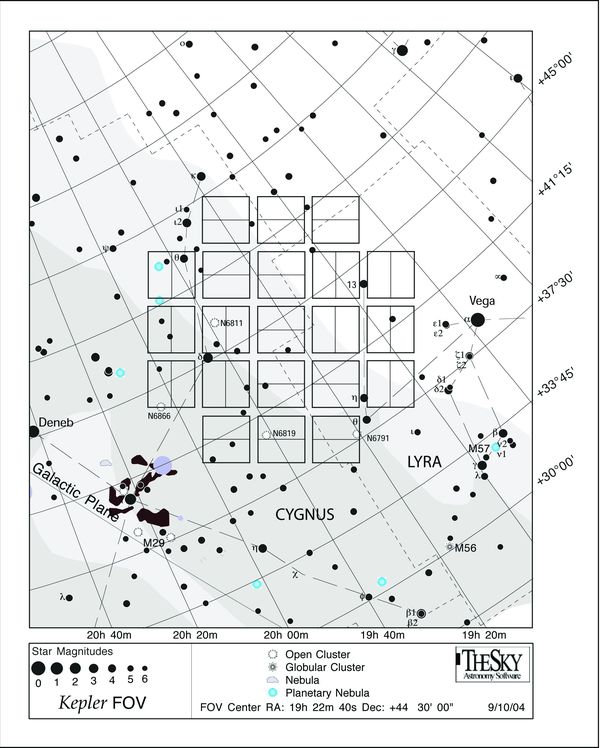
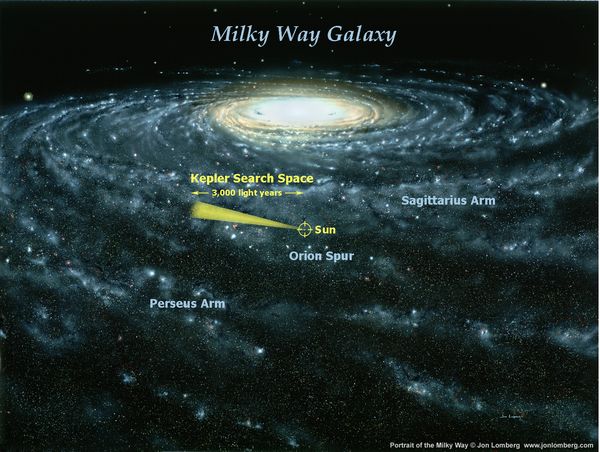
Kepler is closely watching a little patch of sky by the constellation Cygnus, pointed along our little section of the Milky Way, carefully avoiding all the brightest stars.

From NASA: Kepler's Field of View (Angle 1)

From NASA: Kepler's Field of View (Angle 2)

The Kepler Technology

Advanced gyroscopes onboard Kepler keep it pointed in exactly the same direction so the scientists at JPL can get unwavering readings on each star in Kepler’s field of view. To detect planets and calculate their orbits with certainty Kepler will have to watch each planet transit two or three times at least. For a planet like Earth, in its star’s habitable zone, the orbit takes about a year. Different sizes and temperatures of stars have habitable zones at different distances, but the Kepler mission will be able to do a good job at detecting planets with orbital periods up to about two years.

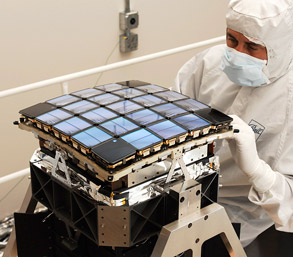
Look at this beautiful picture of the Kepler CCD array (from NASA). Ooo! Shiny!

New News: Hundreds of Planet Candidates Found

Characteristics of Kepler Planetary Candidates Based on the First Data Set: The Majority are Found to be Neptune-Size and Smaller

Authors: William J. Borucki, for the Kepler Team

(Submitted on 14 Jun 2010)

Abstract: In the spring of 2009 the Kepler Mission conducted high precision photometry on nearly 156,000 stars to detect the frequency and characteristics of small exoplanets. On 15 June 2010 the Kepler Mission released data on all but 400 of the ~156,000 planetary target stars to the public. At the time of this publication, 706 targets from this first data set have viable exoplanet candidates with sizes as small as that of the Earth to larger than that of Jupiter. Here we give the identity and characteristics of 306 of the 706 targets. The released targets include 5 candidate multi-planet systems. Data for the remaining 400 targets with planetary candidates will be released in February 2011. The Kepler results based on the candidates in the released list imply that most candidate planets have radii less than half that of Jupiter.

Comments: Paper to accompany Kepler’s June 15, 2010 data release; to be submitted to Astrophysical Journal
Subjects: Earth and Planetary Astrophysics (astro-ph.EP)
Cite as: arXiv:1006.2799v1

(added 6/15/2010 3pm)

Want More?

Kepler’s Website (Official Honoree of the Webby Awards!)

The New Worlds Atlas

The Extrasolar Planets Encyclopaedia – a good resource for the latest exoplanet totals and discoveries.

~ A l i c e !

arXiv:1006.2799v1 [astro-ph.EP]

Answering Questions: Life on Other Planets?

Here are my questions:

  1. What is the possibility that intelligent life on other planets exists?

  2. Have we found any signs of life on other planets?

  3. What is the possibility that any life will be found on a moon such as Europa or Titan?

Again, I greatly appreciate your time, and thank you in advance for your response.

Many Thanks,

-Jacob

Jacob, ahh, these are the questions driving our exploration of the solar system.

1. What is the possibility that intelligent life on other planets exists?

This question is more of an opinion question at this point than a science question. There are just beginning to be scientists attempting to put a number to the possibility that there is life on other planets. I’d like to break this question down.

Life within our solar system (other than on Earth)

There is no evidence of intelligent life within our solar system. This does depend on your definition of intelligent, but one definition sometimes used by astronomers is that intelligent aliens would be able to form civilizations and use radio communication. We would have picked up those radio signals long ago had they been created within our solar system. It is entirely possible that there is life that is not creating radio signals – but we might have detected that life in other ways too:  noticing extra heat, carbon dioxide, oxygen, or methane in the atmospheres of other planets and moons within our solar system.

There is a scientist – Dr. Abel Méndez from Puerto Rico who is studying how likely it is that life could survive (the habitability of) on various planets and moons. He has actually ranked Enceladus, Saturn’s moon, as having more habitable area than Earth!!

Life outside our solar system

Since we have not yet found evidence of life outside our solar system, we have no way of knowing if it is there or not. If you like, you can use the Drake Equation to make your own guess, based on your own choices for the percentage of stars that you think might have planets, and the percentage of those that might be habitable.  If you talk to your math teacher about how to use this formula you can get your own best guess. If you’d rather though, scroll to the bottom of this page and choose the numbers you like best, and the webpage will calculate it for you.

2. Have we found any signs of life on other planets?

Hmm. Not really. Scientists are looking for what they call “markers” of life or “markers of biogenic activity” (both phrases mean the same thing). For instance – if you see dog poop in the park, although the poop isn’t alive you can be pretty certain that there was a dog at that exact location not too long ago. Most of the markers scientists are looking for aren’t nearly as certain as that.

Methane

A while ago scientists studying Mars found new methane in the atmosphere. Methane is often produced when life forms digest food – it comes out of your body when you burp or fart. Bacteria make methane too, as do dogs, cows, and other animals. Unfortunately, the rock cycle can also make methane – especially when iron rusts. Mars is covered in rust – that’s why it is red. This discovery of methane could be either from geology or from biology, it is not necessarily a “marker of life.”

Magnetotactic Bacteria

Last week I wouldn’t have mentioned this, but there is a new scientific paper out this week. In 1996 scientists found what they thought were markers of life in a meteorite from Mars. This meteorite (ALH 84001) was discovered in Antarctica in the early 80s. There were two interesting things inside this meteorite: forms that might be fossilized bacteria, and strings of magnetite (a magnetic mineral). We can’t really tell about the shapes that might be fossilized bacteria, but the strings of magnetite are identical to magnetite strings created by certain bacteria (magnetotactic bacteria) here on Earth. This is a very new paper, so other scientists might have other ways to interpret the same information.

3. What is the possiblity that any life will be found on a moon such as Europa or Titan?

If you look at the work done by Dr. Abel Méndez it looks fairly likely that life might have begun on Europa or Enceladus. Titan is less likely, as is Mars. How likely is it that the life is still there or that we’ll find it? I don’t know. Scientists are constantly debating this one.

Useful Links

Dr. Abel Méndez on Planet Habitability

Methane on Mars

Magnetotactic Bacteria

Magnetotactic Bacteria from NASA

Advanced Links (My source material)

(These are source material, but I do not recommend them unless you want to spend hours piecing through the jargon)

Press release about Méndez’s work, with diagram

Méndez’s current abstract

Méndez’s previous article

~ A l i c e !

Planets Cards!

Do you need a Solar System? I’ve got one for you.
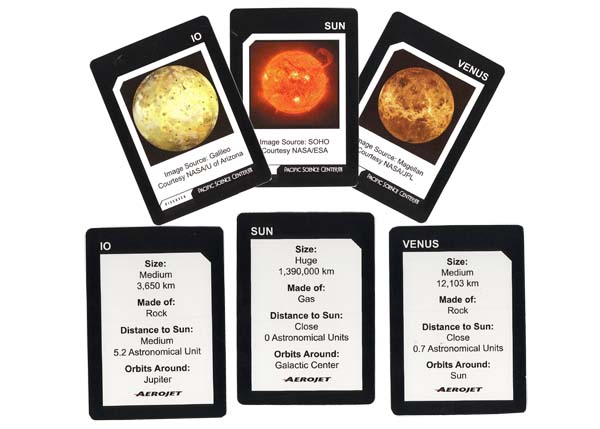
Bear with me, deep linking to the following website doesn’t work, so follow these quick instructions to acquire your own Solar System:

  1. Go to Pacific Science Center’s website: http://www.pacificsciencecenter.org/
  2. Click on “Store” in the middle of the right-hand column.
  3. Click on “Gifts” in the left column.
  4. Click on “Educational” in the middle pane.
  5. You’re there! See “Solar System Cards” in that list? I made those. There are 44 awesome objects in our Solar System – plus several blanks and a list of suggested activities.

Funny Story:

So a few years ago, shortly after receiving my teaching certificate, Pluto was “demoted.” (In fact, my very first AstroInfo was about the new definition of planet!) Although people have many, many feelings about this, and there’s an ongoing argument, I’m going to ignore that part of the story for the time being.

What this created was a difficulty for teachers. Do we still teach Pluto? Does “My Very Eager Mother Just Served Us Nine Pizzas” become “My Very Eager Mother Just Served Us Nachos”? Does “Mary’s Violet Eyes Made John Stay Up Nights, Period” become “Mary’s Violet Eyes Made John Stay Up Nights”? What if Pluto is reinstated next year? What if you live in Illinois?

Well, the first question is easy. You most definitely still teach about Pluto. It’s not like the demotion made it evaporate out of our Solar System or disappear into nothingness. In fact, now it is probably more important to teach Pluto, since it’s the best-known representative of several whole classes of objects (Kuiper Belt Objects, Plutinos, Dwarf Planets, and Trans-Neptunian Objects). As we discover more and more of these, kids (and adults) need to know at least where these new discoveries are taking place. Teaching about Pluto helps with that.

But if it’s not a planet, what is it? What do I call it? What if they change the name? How can I teach science, if science is changing all the time? Those first two questions you can look up on the internet. The second two suggest some thought.

How can I teach science, if science is changing all the time?

This is a great question, and it applies to more than just “The Pluto Debate,” but that’s where I started. And it turns out, I wasn’t the only educator working on this problem. Anna Hurst from the Astronomical Society of the Pacific, and John Ericson at the Lawrence Hall of Science were also focusing on giving teachers a new way to teach the Solar System in the wake of The Pluto Kerfuffle. We were not in correspondence. We were not discussing this with each other, we did not meet and work on this problem together. In fact, I don’t think I met either of them until long after this.

Yet we all came up with the same solution: a set of cards or slips of paper, each with information about a different object in our Solar System.  Teaching the Solar System was going to have to evolve from “facts about each of the nine planets” to something that was more closely related to a lot of what planetologists actually do: classify, categorize, and identify. This mean that the new way of teaching the Solar System needed to involve dozens of objects, not just eight or nine, because there are actually dozens, hundreds, thousands of objects in our Solar System!

Besides the inherent flexibility and educational merit of this new activity, it also gives you a positive and fun way to teach about what happened to Pluto. You can allow your students to make their own definitions for planet, and see which objects fit (or don’t fit) their definition.

Anyway, I find it fascinating that the three of us came up with the same activity independently. I’m sure that many other teachers around the world also must have thought of this idea too, and so I claim no copyright or patent on the activity, but if you don’t have time to make your own set of 30-50 cards, you can (finally) just purchase a set from us – and support both my job and my planetarium while you’re at it!

If you’re interested in  John and Anna’s versions:

Lawrence Hall of Science Gread Explorations in Math and Science (since I can’t remember exactly which module has this activity, I’ll send you to the general link. If you know where it is, let me know!)

Astronomical Society of the Pacific’s The Universe in the Classroom, Issue #70 Hubble Observations of Pluto and Ceres. Scroll all the way down to “Activity 1: Sorting the Solar System” and the cards are there.

There is also a printable (draft) version of my cards, but I recommend ordering a nice set from above, since all the attributions for the photographs are correct, and multiple people have proofread them. The drafts will get you through the activity just fine, but the cards are a bit better.